

Recognition Givers Trusted 9x More Than Receivers, Study Finds
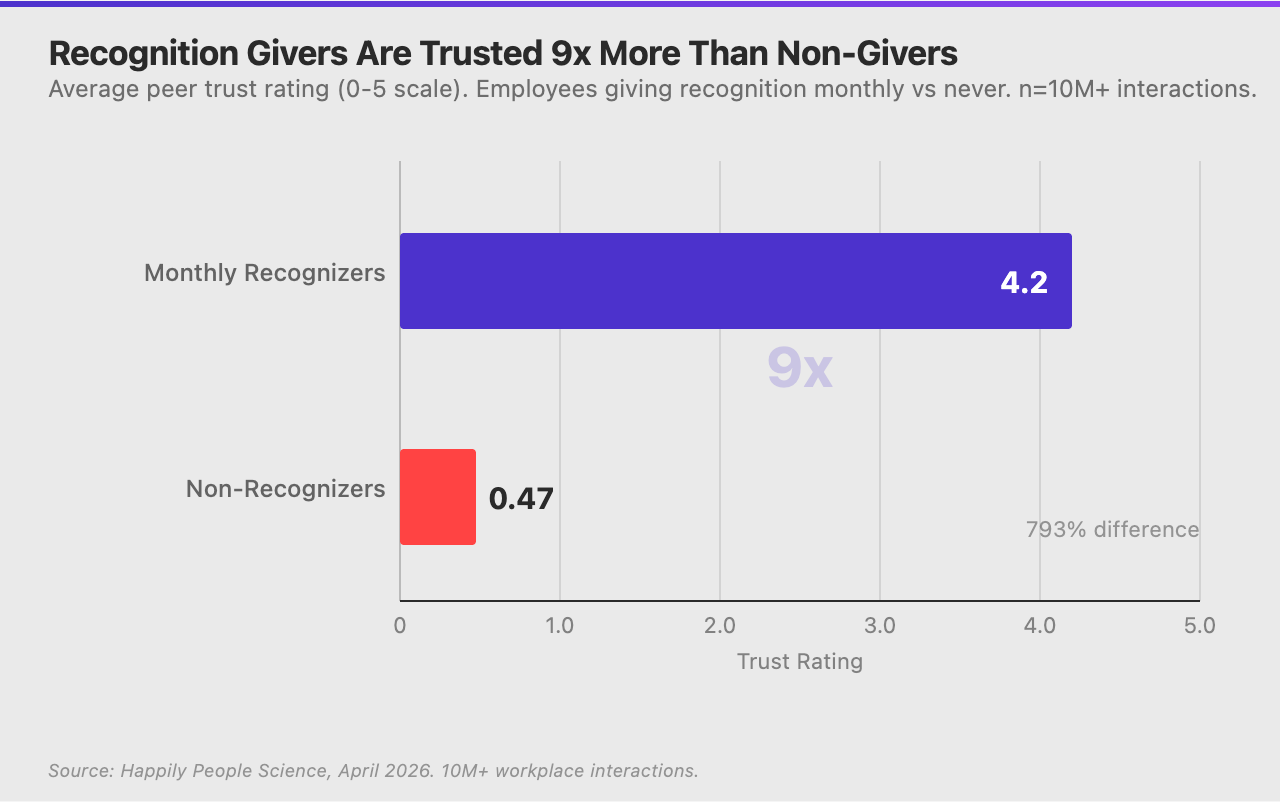
Recognition givers are trusted 9x more than non-givers. Average peer trust rating on 0-5 scale.
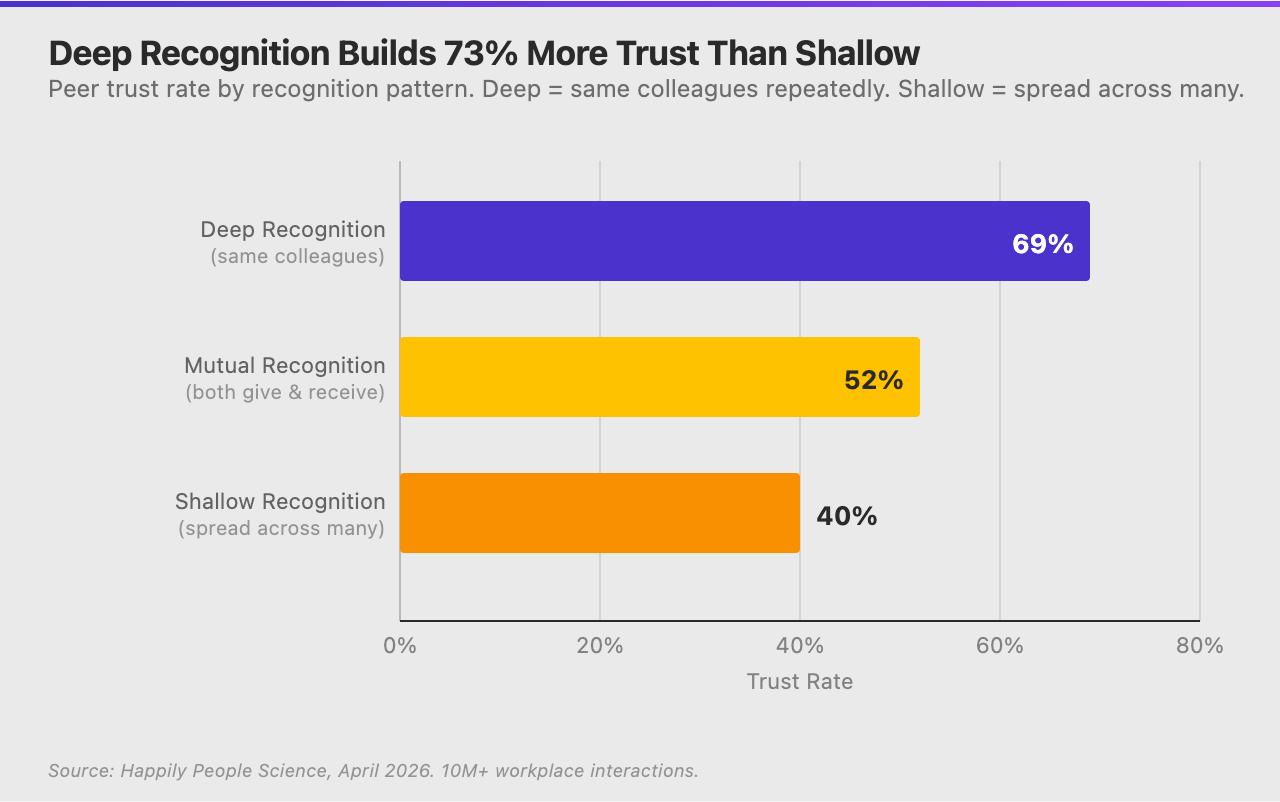
Deep recognition builds 73% more trust than shallow. Peer trust rate by recognition pattern.
Analysis of 10 million+ workplace interactions reveals most recognition programs optimize for the wrong behavior
The research draws on nine years of daily behavioral data across 350+ organizations. Unlike traditional engagement research, trust was not measured through self-reported surveys. Instead, Happily.ai tracked peer-to-peer interaction patterns, collaboration frequency, and response behaviors - observable signals that reflect how colleagues actually experience each other, not how they say they do.
The recognition trust paradox becomes even more pronounced when mutual recognition is analyzed. Employees who both give and receive recognition consistently achieve a 52% peer trust rating - 20.8x the baseline rate of non-participants. The pattern suggests trust is not a one-way reward but a feedback loop: giving recognition invites recognition in return, and the cycle compounds.
A second finding runs counter to how most recognition programs are designed. Employees who recognized the same colleagues repeatedly - building depth rather than breadth - achieved 69% trust rates, compared to 40% for those who spread recognition thinly across many colleagues. Most corporate recognition programs are explicitly designed to maximize breadth: encourage everyone to recognize everyone. The data suggests this design may actively undermine the trust-building mechanism.
"Most recognition programs are built to solve a fairness problem - make sure everyone gets noticed," said Tareef Jafferi, Founder and CEO of Happily.ai. "But our data shows the trust benefit flows from the habit of giving, not from broad distribution."
The arrival of this research coincides with a broader industry problem. Despite significant investment in recognition platforms, adoption averages just 25% across the industry. Happily.ai's analysis suggests this is not a technology problem - it is a design problem. Programs built around who receives recognition create passive participants. Programs built around the habit of giving create active, trust-generating behaviors.
When Happily.ai redesigned its platform around giving behavior - making recognition peer-driven, frequent, and easy rather than top-down and annual - voluntary adoption reached 97%. Organizations using this approach reported 40% lower unwanted turnover compared to their pre-adoption baselines.
"The implication for program design is uncomfortable: recognition programs that push people to recognize as many colleagues as possible may actually be working against themselves," Jafferi added. "The data points toward fewer, more consistent acts of recognition between close collaborators."
Companies evaluating their recognition programs can access the full research and methodology at https://happily.ai/blog/recognition-trust-multiplier.
About the Research
Happily.ai's recognition trust findings are drawn from an analysis of more than 10 million workplace interactions across 350+ organizations over nine years (2016–2025). The dataset spans companies in Southeast Asia, North America, Europe, and Australia, across industries including technology, financial services, manufacturing, and professional services, with company sizes ranging from 50 to 5,000+ employees. Trust was measured through behavioral indicators rather than self-reported survey scales. The depth-over-breadth finding (69% vs. 40%) and the mutual recognition multiplier (20.8x baseline) have not been externally peer-reviewed. Independent replication is encouraged.
About Happily.ai
Happily.ai is a Culture Activation platform that transforms organizational culture through daily behavioral change rather than periodic measurement. Built on behavioral science and gamification, the platform achieves 97% adoption (vs. 25% industry average) by making participation intrinsically rewarding. CEOs get continuous visibility into team health, alignment, and goal progress. Clients experience 48-point eNPS improvements, 40% reductions in turnover, and $480K in annual savings per 100 employees.
Learn more at https://happily.ai
Tareef Jafferi
Happily.ai
+66 83 689 5235
tareef@happily.ai
Legal Disclaimer:
EIN Presswire provides this news content "as is" without warranty of any kind. We do not accept any responsibility or liability for the accuracy, content, images, videos, licenses, completeness, legality, or reliability of the information contained in this article. If you have any complaints or copyright issues related to this article, kindly contact the author above.
